The Oregon Flex Lending program is Oregon Housing and Community Services’ home loan program. It pairs a fixed-rate first mortgage, either FirstHome (for first-time buyers) or NextStep (open to repeat buyers) with down payment assistance of either 4% or 5% of the loan amount, which can cover up to 100% of your cash to close.
Get the real scoop on these new Oregon Flex programs. Most websites are still talking about the Oregon Bond programs that have been discontinued. The “Cash Advantage” and “Rate Advantage” programs no longer exist. Here’s what the new FirstHome and NextStep programs require in 2026. We’ve gone through the fine print so you can see how these new programs work for you!
NW Capital Mortgage is an OHCS-approved lender serving Portland, Salem, and buyers throughout all of Oregon. We know the ins and outs of these programs! Get a quote.
What Is the Oregon Flex Lending Program and How Does It Work?
The OHCS Oregon Flex program consists of two main sub-programs: FirstHome and NextStep. Both programs are first mortgages that can be paired with OHCS down payment assistance of 4% or 5% of the first mortgage loan amount. Since the required down payment is typically 3.5% or less, either 4% or 5% is more than enough to cover the down payment.
This means you may be able to buy a home without needing to save any money for a down payment.
The FirstHome or NextStep mortgage can be either a conventional, FHA, VA, or USDA loan. We will help you determine which is best for you.
All properties must be Single-Family Residences, Owner-Occupied, and located in Oregon. Loans are originated by OHCS-approved lenders such as NW Capital Mortgage.
The Flex Lending programs FirstHome and NextStep replace the discontinued Oregon Bond Residential Loan Programs, Cash Advantage and Rate Advantage. Don’t trust any websites that don’t make this explicitly clear, as they are outdated.
Are There Eligibility Requirements for the Oregon Flex Lending Program?
Yes, there are eligibility requirements. Here are a few of the key requirements that apply to both FirstHome and NextStep. Each program has additional requirements discussed elsewhere in this blog.
- Credit score of 620 minimum on both FirstHome and NextStep.
- Homebuyer education required for all first-time buyers. That said, we recommend that you get pre-approved before taking the education. While the Flex Lending programs work for many homebuyers, we also offer other programs for those who do not qualify for Flex Lending. Those programs have different education requirements. We recommend waiting until we know which education is required for your specific situation.
- Homebuyers using the Flex Lending programs may not own any other real estate at closing.
- You must occupy the property as a primary residence within 60 days of purchase.
- No minimum borrower investment required. This means it is technically possible to buy a home with nearly $0 of your own money (in the end). That said, there are some upfront cash outlays for things that can be reimbursed to you later in the process.
TRUE STORY: Our clients recently bought a home using a Down Payment Assistance program. They put down a $1,000 earnest money deposit. They then paid about $600 for a home inspection, and finally about $825 for their appraisal. Since their realtor negotiated that the seller would pay most of their closing costs, we were able to reimburse them for the appraisal and refund them all but $22 of their earnest money. In the end, they were able to move into the home with a final cash outlay of less than $700.
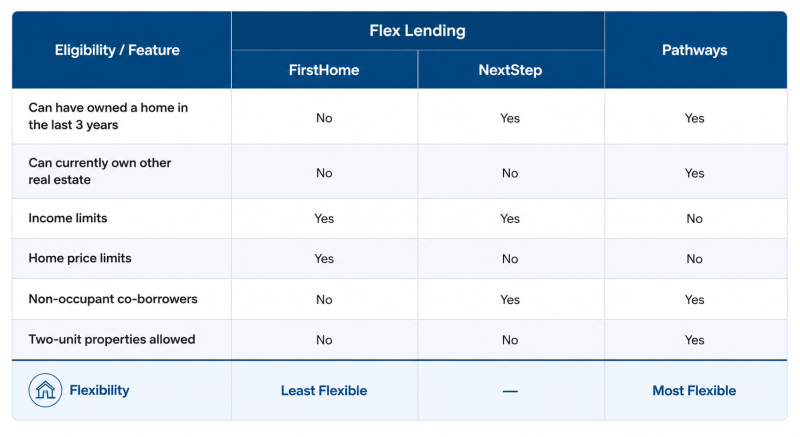
Oregon Flex Income Limits, and the Difference Nobody Explains
Here is a typical process to determine which down payment assistance program is best for you.
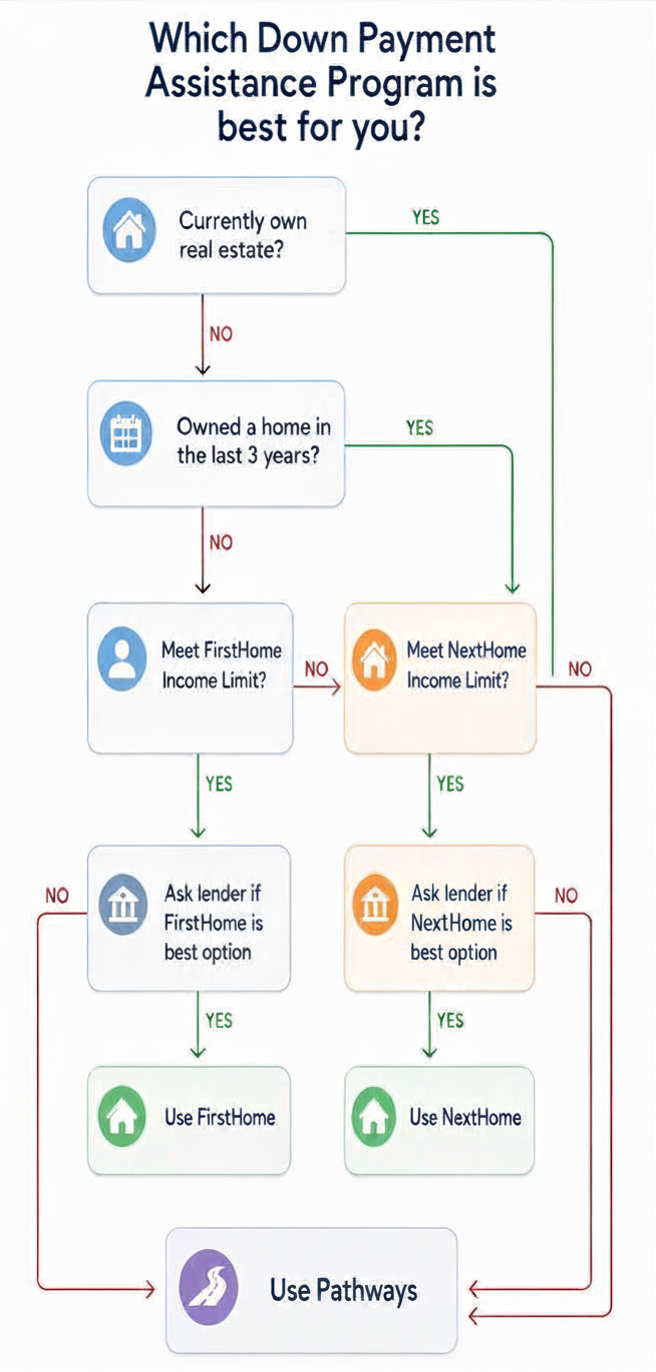
If you can qualify for the FirstHome program, it is almost always the best down payment assistance program to use (unless you are an eligible veteran). Currently, OHCS is offering substantially lower rates on the FirstHome program. The NextHome program and the Pathways program are both outstanding programs to look at if you’re not eligible for FirstHome.
Determining if you qualify for the FirstHome income limits can be difficult. Here is the process to do that—or get a quote, and we’ll walk you through your options.
Step 1: Determine your total household income
This includes all sources of income for any household member age 18 or over (whether or not they will be on the loan). This includes your 18-year-old with a part-time job. It also includes non-earned income, like pensions, unemployment, and Social Security.
Step 1b: Compare your income with the county income limit table for non-targeted areas.
If you’re within this limit, you have the most flexibility.
Step 1c: Compare your income with the county income limit table for targeted areas.
If you’re over the non-targeted area limit, but under this limit, you’re allowed to buy in targeted geographic areas only.
Step 2: If you cannot use FirstHome, see if you qualify for NextHome
If you are not qualified for FirstHome, there is still a chance you may qualify for NextHome. NextHome income limits are very different from FirstHome’s. NextHome income limits are based only on the qualifying income of the homebuyers on the loan. While the statewide limit is $125,000, you may be able to qualify for NextHome by leaving a potential borrower off the application.
EXAMPLE: Let’s assume a married couple earns $200,000 per year. Joe makes $120,000 per year, and Juanita makes $80,000 per year. While they are not eligible for FirstHome, they may be eligible for NextStep if they can otherwise qualify for the loan using only Joe’s income of $120,000 per year and only include Joe on the loan application.
Need help determining which program to use? Contact us.
Exceptions to FirstHome First-Time Homebuyer Requirement
While you generally cannot use the FirstHome program if you have owned a home in the past three years, there are some exceptions.
- Veterans who haven’t previously used a mortgage revenue bond program can typically use the FirstHome program as long as they don’t currently own a home. Given that VA loans allow a veteran to buy a home with no down payment, we consider all available options to determine whether a DPA program makes sense.
- Buyers in targeted areas (IRS-designated qualified census tracts, which include parts of the Portland metro) are also exempt from the first-time buyer requirement.
- Homebuyers may still use FirstHome if they have owned bare land or a manufactured home in a park in the past three years. But they cannot currently own those properties at closing.
Do FirstHome and NextStep have Home Price Limits?
First the good news! The NextStep program has no home price limits.
The FirstHome program does have home price limits, however. These limits vary by county and are slightly higher in targeted geographic areas. Click here to see the current home price limits for the FirstHome program.
Is There Down Payment Assistance Available if I am Not Eligible for FirstHome or NextStep?
Yes, we have you covered! Our proprietary Pathways DPA program works in many situations where FirstHome and NextStep don’t. Such as:
- No income limits
- No first-time homebuyer requirement*
- No home price limits*
- You can own other real estate
- You can buy a two-unit property
- Non-occupant co-borrowers are permitted*
- Credit scores between 580 and 619 are possible (Oregon Flex minimum is 620)
* NextStep also allows these situations.
What Is a Focused Demographic? And Why Does It Matter?
For both the FirstHome and NextStep programs, the amount of down payment assistance is typically 4% of the first mortgage loan amount. Some people in “focused demographics” can receive down payment assistance equal to 5% of the loan amount. This applies to you if you meet two of the following four criteria:
- Household of four or more people
- A household member with a qualifying disability (we can help you determine this)
- A housing cost-to-income ratio of 28% or higher
- A sole head of household with a qualifying dependent (under 18, has a disability, or 62 or older)
How the Down Payment Assistance Works (Forgivable vs. Repayable)
The structure of payments on your down payment assistance is largely determined by your income level relative to the annual median income (AMI) of the county where you are purchasing your home. Here are the important facts.
Income less than 80% of AMI
This is the best tier to be in. You will have no monthly payment on your DPA second mortgage.
Your DPA second mortgage is “forgivable.”
This means that if you hold the loan to maturity, you never need to repay the second mortgage. For focused demographics, the maturity date is 15 years. For all others, the maturity date is 30 years.
You must immediately pay off the DPA second mortgage in any of the following cases:
- Sale or transfer: If all or any part of the property, or any interest in the property (including a beneficial interest), is sold, conveyed, or transferred, whether voluntary, involuntary, or by operation of law.
- Refinance or payoff: Refinancing or paying off the first mortgage loan.
- Rental of property: If borrower rents or leases (whether by written or oral agreement) the property or any portion of the property.
- Failure to occupy property as principal residence: If borrower fails to occupy the property as their principal residence within 60 days following the first mortgage loan closing.
- Default or acceleration: Upon default or acceleration of the first mortgage loan for any reason.
Another bonus: If your income is less than 80% of AMI, the program allows you to receive reduced mortgage insurance on a conventional loan.
Income of 80% to 120% of AMI
- You will need to make monthly payments on your DPA second mortgage.
- Your interest rate will be 1% more than the interest rate on your first mortgage.
- If your loan was a focused demographic DPA second of 5%, your payments will be based on a 30-year amortization.
- If your loan was a standard DPA second mortgage of 4%, your payments will be based on a 20-year amortization.
Income of Over 120% of AMI
- You will need to make monthly payments on your DPA second mortgage.
- Your interest rate will be 1% more than the interest rate on your first mortgage.
- Your payments will be based on a 10-year amortization.
Contact us if you would like help determining your repayment amount.
Can You Refinance with the Oregon Flex Lending Program?
No. Flex Lending is purchase-money only. There is no Flex Lending refinance product. Anyone telling you otherwise is confusing it with something else.
However, this doesn’t mean you can never refinance your Flex Lending mortgage. You can refinance a Flex Lending mortgage using a standard mortgage program. This can make sense in many cases when rates have dropped.
If you later refinance your Flex Lending first mortgage, the outstanding DPA second mortgage becomes due and must be paid immediately. Because of this, any decision to refinance your mortgage requires careful analysis. At NW Capital Mortgage, we are experts at providing the information you need to determine whether refinancing makes sense in your situation.
Example: Our client has a 6.5% interest rate on their NextStep first mortgage and a “forgivable” DPA second mortgage. They have had their home for two years. They are quite certain they will be moving within seven years. Given that they will move within seven years, the “forgivable” DPA second mortgage will never be forgiven (they won’t reach 30 years in the home). In this case, we will help them understand the refinancing costs and compare them to the monthly savings over time if they refinance. This gives them the information they need to determine if refinancing makes sense.
If you already have a Flex Lending loan and are weighing a refinance, our team can model the costs and benefits to help you make the right decision for your situation. Contact us.
What Are the Interest Rates on Oregon Flex Lending Loans?
OHCS sets rates, posted daily, with a defined daily lock window. Every approved lender quotes the same program rate on a given day. Here are a few key points about interest rates on Oregon Flex loans:
- Rates for FirstHome are typically at or below market for the borrower’s profile.
- Rates for the NextStep program are typically close to the market rate.
- The greatest value of FirstHome and NextStep is the down payment assistance.
- In some cases, you can get lower rates and payments with a regular VA, USDA, FHA, or conventional loan program.
If you have funds that could be used for down payment and don’t necessarily need down payment assistance, get a quote, and we’ll run some scenarios for you.
What Documents Do You Need to Apply?
The mortgage documentation required for these loans is very similar to a normal mortgage loan. We generally need:
- Two years of W-2s
- 30 days of pay stubs
- Two months of asset statements
- Two years of tax returns if self-employed
If applying for a FirstHome loan, we will need your past three years of tax returns, whether you are self-employed or not, as this is a requirement of that specific program.
We will give you a complete list of any additional documentation needed after reviewing your loan application.
Does Oregon Flex Lending Cover First-Time Homebuyers?
Yes, FirstHome is built for first-time homebuyers. This generally means someone who hasn’t owned a primary residence in the past three years. But NextStep exists precisely so that repeat buyers aren’t shut out. That said, neither FirstHome nor NextStep allows a homebuyer to own any other real estate.
The Flex Lending programs offered by OHCS through NW Capital Mortgage help many homebuyers in the Portland, Salem, Eugene, and Bend areas buy the home they want. We help our clients throughout Oregon achieve their dream of homeownership.
FAQs
What are the Oregon Flex income limits for FirstHome and NextStep?
The income limit for the NextStep program is currently $125,000 qualifying income for all borrowers statewide. The income limit for the FirstHome program is calculated on the total income of all household members 18 or over. These income limits also vary by county and can be found here for non-targeted areas and here for targeted areas.
Can I refinance my mortgage through the Oregon Flex Lending program?
You cannot refinance a mortgage through the Oregon Flex Lending program. This program is designed for home purchase loans only. That said, it is possible to refinance an Oregon Flex Lending loan into a standard mortgage loan. We have tons of experience with that process and can help you determine whether it makes sense for you.
What are the interest rates offered by the Oregon Flex Lending program?
The interest rates for the Oregon Flex Lending program are set daily and posted on the OHCS website. On any given day, all approved lenders, such as NW Capital Mortgage, offer the same rates. We suggest you pick your lender based on knowledge and service. We are experts in these loan programs and would love to help you. Get a quote.
What documents are needed to apply for the Oregon Flex Lending program?
The Flex Lending programs are “full doc” programs that require all the standard income and asset documentation of a normal VA, USDA, FHA, or conventional loan. Typically, this includes (at least) W2s, pay stubs, and bank statements. Additionally, the FirstHome program requires we get three years of tax returns from all household members (with income). For more information, click here to visit our documentation page or here to apply; we will provide a custom documentation list.
Does the Oregon Flex Lending program cover first-time homebuyers?
Absolutely, the FirstHome program is specifically targeted at anyone who has not owned a home in the past three years. Additionally, the NextHome program is available to first-time homebuyers. NextHome is a great program to consider as a first-time homebuyer if you do not meet the requirements for the FirstHome programs. We also offer many other programs for first-time homebuyers.
Do I have to pay back the Oregon Flex down payment assistance?
There are some circumstances where you do not need to repay Oregon Flex down payment assistance. If your income is below 80% of the annual median income for the county you purchase your home in, you may qualify for a “forgivable” DPA second mortgage. In this case, you will not have a monthly payment on the DPA second mortgage. If you keep the loan for the full term, it can be forgiven. The full term is either 15 or 30 years, depending on factors we can help you understand. Contact us.
Can I use Oregon Flex Lending to buy a home in Vancouver, Washington?
You cannot use an Oregon Flex Lending loan to buy a home in Vancouver, Washington. But Washington has its own program offered by the Washington State Housing Finance Commission.
Can I rent out a room in a home bought with Oregon Flex Lending?
No, you cannot rent any portion of a property with an Oregon Flex Lending home loan. Further, the home must remain owner-occupied for the duration of the loan. We can help you find a program that works for your situation. Contact us.