
Refinancing your home loan can help lower your monthly payment, shorten your term, or free up cash for other goals. For homeowners across Oregon and Washington, understanding when to refinance—and what the process involves—can lead to meaningful long-term savings.
Top 3 Reasons to Refinance Your Washington or Oregon Home
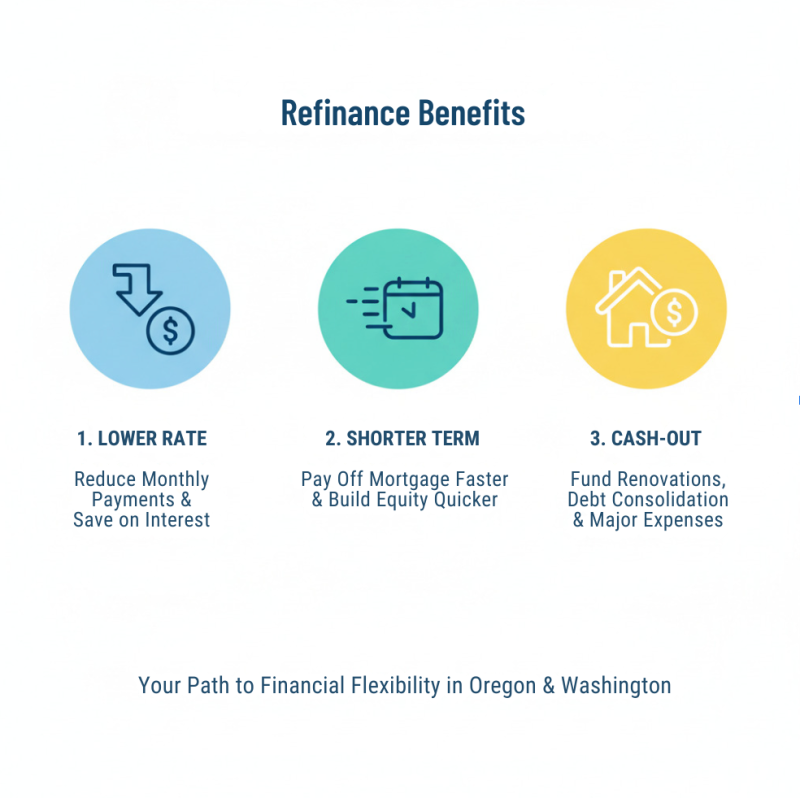
- Lower your interest rate: Secure a better rate than your original mortgage to reduce monthly payments and total interest paid.
- Shorten your loan term: Switch from a 30-year to a 15-year mortgage to build equity faster and pay off your home sooner.
- Access home equity: Use a cash-out refinance to fund renovations, consolidate debt, or cover major expenses.
Whether refinancing is the right move for you depends on your goals, current interest rate, credit score, and how long you plan to stay in your home. This guide covers everything you need to know about refinancing in Oregon and Washington, from market conditions to the application process
Why Refinance Now?
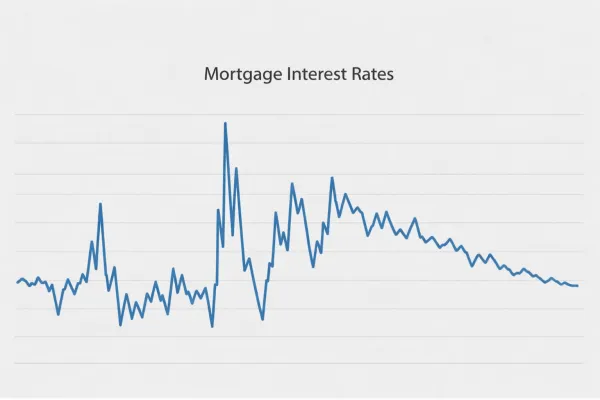
Timing matters when you’re thinking about refinancing. Mortgage rates have been on a journey, starting 2025 at around 7% before nudging downward.
Oregon’s housing market remains strong, with a median home value of $496,180. Washington homeowners are seeing similar trends, with a median home value of $595,738. If you’ve owned a home in the Pacific Northwest for a few years, you’ve likely built substantial equity, which can be a powerful tool.
With rates stabilizing at more favorable levels and home equity at healthy levels, now is an excellent moment to reassess your mortgage and see if refinancing aligns with your financial goals.
What are the current rates for a refinance in Oregon or Washington?
The answer: Mortgage rates change daily. Your actual rate depends on several factors:
- Your credit score: Higher scores (740+) typically secure the lowest rates.
- Your loan-to-value (LTV) ratio: More equity generally means a better rate.
- The loan amount: Jumbo loans may have different rates.
- Points: You can often pay points upfront to “buy down” your interest rate.
While we can’t give you a fixed rate here, we can explain some options. 30-year fixed-rate mortgages offer lower monthly payments, while 15-year fixed-rate mortgages have higher payments but let you pay off your home much faster. Adjustable-rate mortgages (ARMs) start with a lower fixed rate before adjusting to market conditions.
For the most accurate, up-to-date rates, contact us for a personalized quote.
Key benefits of refinancing your mortgage
Refinancing can help you reach your financial goals in several ways:
- Lower monthly payments: Securing a lower interest rate can reduce your monthly payment, freeing up cash in your budget.
- Shorten your loan term: Switching from a 30-year to a 15-year loan helps you build equity faster and own your home sooner, saving thousands in total interest.
- Pay off your mortgage faster: Even with the same term, a lower rate means more of your payment goes to the principal if you continue paying the original amount.
- Consolidate high-interest debt: A cash-out refinance can convert high-interest credit card or personal loan debt into a single, lower-interest mortgage payment.
- Access your home equity: Use a cash-out refinance to fund home renovations, college tuition, or other major investments.
- Switch from an ARM to a fixed rate: Gain peace of mind with a stable interest rate and a payment that won’t change.
Understanding Your Refinance Loan Options
When you refinance in Oregon or Washington, you’ll find several options designed for different goals. The key is choosing the one that best aligns with your needs.
The two main types:
- Rate-and-term refinance: This is the most common type. You replace your existing mortgage with a new one to get a lower interest rate, get a shorter loan period, or switch from an adjustable to a fixed rate. You are not taking cash out.
- Cash-out refinance: This option allows you to tap into your home’s equity by borrowing more than you owe. The difference comes to you as cash for renovations, debt consolidation, or other expenses.
You’ll also choose between a fixed-rate mortgage, which offers a stable interest rate and payment for the life of the loan, and an adjustable-rate mortgage (ARM), which has a lower initial rate that can change after a set period.
| Feature | Fixed‑Rate Mortgage | Adjustable‑Rate Mortgage (ARM) |
|---|---|---|
| Interest Rate | Stays the same for the life of the loan | Fixed initially, then adjusts periodically |
| Monthly Payment | Predictable and stable | Can change after the fixed period |
| Risk | Low interest‑rate risk | Higher interest‑rate risk after fixed period |
| Best For | Long‑term homeownership, budget stability | Shorter‑term plans, lower initial payments |
Common loan programs
We offer a variety of loan programs to fit different financial profiles:
- Fixed-rate mortgages: The most popular choice, available in 15-, 20-, or 30-year terms for predictable payments.
- Adjustable-rate mortgages (ARMs): Can offer lower initial rates, which is attractive if you plan to sell or refinance before the rate adjusts.
- FHA loans: Backed by the Federal Housing Administration, these are great for borrowers with lower credit scores or less equity. They require a mortgage insurance premium (MIP) but can still be an excellent choice.
- VA loans: An exclusive benefit for eligible service members, veterans, and surviving spouses. They require no down payment or private mortgage insurance (PMI) and offer excellent refinance options.
- Jumbo loans: For loan amounts that exceed conforming limits (e.g., $1,037,300 in King County as of 2025: $832,750 in much of Washington and Oregon). These are often necessary for refinancing higher-value homes in the Pacific Northwest. However, we have some other excellent options.
Local lenders and personalized service
Choosing the right lender is as important as choosing the right loan. As a Northwest-based company, we offer tangible benefits over large national lenders:
- Local expertise: We have intimate knowledge of the Oregon and Washington housing markets, providing relevant, specific advice.
- Personalized service: Our experienced loan officers take the time to understand your goals and guide you through the process. You’re not just an application in a queue.
- Member-focused approach: We work hard for you, offering competitive rates and a transparent process. Our success is tied to your success.
- Community involvement: We are part of the communities we serve, building trust and accountability. We’re your neighbors committed to helping you thrive.
Step-by-Step Guide to Your Refinance in Oregon or Washington
Thinking about a refinance in Oregon or Washington? The process is more straightforward than you might think, and many of our clients close on their new loan in about 30 days or less. That said, if there has been a recent rate drop, lenders can get backed up. We will let you know what to expect when we talk with you.
Here’s an overview of the journey. For a detailed breakdown, visit our loan process page.
Step 1: Determine if refinancing is right for you.
Before diving in, make sure refinancing aligns with your financial picture. Ask yourself:
- What are my goals? You might want to secure lower payments, pay off debt, or access cash.
- How long will I stay in the home? You’ll want to stay long enough to pass the “breakeven point,” where your monthly savings cover the closing costs.
- Does my current loan have a pre-payment penalty? Check your loan documents for any fees for paying off your mortgage early. It is rare to have a pre-payment penalty. But it is important to know if you do.
- Can I afford the closing costs? These can vary significantly depending on your situation. We can help you analyze whether the costs are worth the long-term savings. We also help you optimize the structure of your loan to minimize costs and/or maximize savings depending on your situation. One size does not fit all. And we help you pick the right path.
When you’re ready, get a quote to see your potential options.
Step 2: Check your eligibility and gather documents.
Next get ready for your application. Lenders will look at your credit, income, and property value. Key eligibility factors include:
- Credit score: A score of 620+ is generally needed, with 740+ often securing the best rates. That said, we have helped clients with lower credit scores.
- Home equity (LTV): The loan-to-value ratio required varies significantly depending on the loan program. Don’t count yourself out just because you may not have much home equity.
- Debt-to-income (DTI) ratio: Some lenders prefer a DTI below 43%, However, we have several loan programs that are much more flexible.
Step 3: Apply.
Don’t hesitate to ask questions. The first step is to complete a full application. We’ll walk you through the best loan programs for you. From there, we’ll process your loan, order an appraisal (if needed), and move toward closing.
Ready to start? Begin your application through our refinance portal.
Frequently Asked Questions About Refinancing in the PNW
Here are answers to some of the most common inquiries we receive about a refinance in Oregon or Washington. For more, visit our frequently asked mortgage questions page.
How much home equity do I need to refinance?
For a conventional rate-and-term refinance, lenders typically require at least 20% equity (an 80% loan-to-value ratio) to avoid private mortgage insurance (PMI). However, options exist for homeowners with less equity:
- FHA streamline refinance: Allows refinancing with very little equity, usually without a new appraisal.
- VA streamline refinance (IRRRL): Offers great flexibility with minimal equity requirements for eligible veterans.
- RefiNow™ program: For those with a Fannie Mae mortgage, this program allows LTVs up to 97% for single-unit homes, subject to income and credit criteria.
For a cash-out refinance, you can generally borrow up to 80% of your home’s value, meaning you must maintain at least 20% equity after the transaction. That said, we have some options that allow many clients to access 10% more equity for a total of up to 90% LTV.
Is now a good time to refinance in Oregon or Washington?
Refinancing can make sense if current rates are lower than your existing mortgage rate or if you have specific financial goals like accessing home equity or shortening your loan term.
Whether now is the right time for you depends on several factors:
- How much lower current rates are compared with your existing rate. A reduction of at least 0.5% in interest rate often makes refinancing worthwhile when we can minimize your upfront costs.
- How long you plan to stay in your home (you need time to recoup closing costs).
- Your current home equity and specific financial goals.
The best approach is to get personalized quotes and calculate your breakeven point to determine if refinancing makes financial sense for your situation.
How much can I save by refinancing my mortgage?
Your potential savings from refinancing depend on your current interest rate, the new rate you qualify for, your loan balance, and your loan term.
- For example, refinancing a $400,000 mortgage from 7% to 6% could save you approximately $240 per month, or nearly $2,900 annually in payments. However, your true interest savings is $4,000 the first year (1% of $400,000).
- Over the life of a 30-year loan, this could mean savings exceeding $86,000 in total interest paid. If you refinance to a shorter term (like switching from a 30-year to a 15-year mortgage), your monthly payment may increase, but you’ll save significantly more in total interest and build equity much faster.
For a cash-out refinance, your savings calculation should factor in the benefit of consolidating higher-interest debt into your lower-rate mortgage. We are experts in helping you with these calculations. It is not uncommon for us to improve a clients cash flow by $500 to $2,000 per month with a debt consolidation refinance.
To get an accurate estimate of your potential savings, you’ll need to compare your current monthly payment and total interest costs against the new loan terms, while accounting for closing costs. Calculate your breakeven point—the time it takes for monthly savings to exceed closing costs—to ensure that refinancing makes financial sense for your timeline. We can help you with those calculations.
Can I refinance with a low credit score?
Yes, though a higher score (740+) typically secures the best interest rates. While many conventional lenders look for a score of 620 or higher, having a lower score doesn’t automatically disqualify you.
Government-backed loans are more flexible:
- FHA loans are known for lenient credit requirements, sometimes accepting scores as low as 580.
- VA loans are also very forgiving for eligible service members and veterans.
If your score isn’t where you’d like it, simple steps like paying bills on time, reducing credit card balances, and checking your credit report for errors can make a big difference. We can help find the best option for your specific credit profile.
What is the difference between a cash-out refinance and a home equity loan?
Both let you access your home’s equity, but they work differently. Choosing the right one for your refinance in Oregon or Washington depends on your goals.
- A cash-out refinance replaces your entire mortgage with a new, larger one. You receive the difference in cash and are left with a single mortgage payment. This is ideal if you want to secure a lower rate on your primary mortgage and simplify your debts into one payment.
- A home equity loan (HEL) or home equity line of credit (HELOC) is a second mortgage. You keep your first mortgage and take out a separate loan or line of credit against your equity. A HEL provides a lump sum at a fixed rate, while a HELOC works like a credit card with a variable rate. This can be a good option if you like your current mortgage terms and need a smaller amount of cash or borrowing flexibility.
Key differences are that a cash-out refinance results in one loan, while a HEL/HELOC adds a second mortgage.
Take the Next Step in Your Refinance Journey
You’ve learned how a refinance in Washington or Oregon can open up amazing financial possibilities, from lowering your monthly payments to funding major life goals. A smart refinance can help you consolidate debt, renovate your home, or even pay off your mortgage years sooner.
The key is working with an expert who understands the local market and your unique needs. At NW Capital Mortgage, we are that team. We’re dedicated to ensuring that your mortgage is working as hard as possible. Ready to see what a refinance can do for you?